
Power Perfumes
Why Strength Sells and How Powerful Scents Became the Fragrance Market’s New Growth Engine

When indie darling Boy Smells rolled out “Boy Smells 2.0” on April 11, everything shifted: formulas were re-engineered for “Bigger Smells. Longer Wear”. Despite the backlash lighting up #PerfumeTok, the update delivered the brand’s biggest sales week in four years, proof that potency has become a core market need.
Why Now?
Four years ago only 10% of perfume launches highlighted longevity; by 2023 it was 35%, a 250 % jump, according to European retailer Douglas. In the U.S., the pattern is similar: Circana reports that sales of Parfums were +43 % and Eaux de Parfum +14 %.
Smellmaxxing — young men turn up the volume
Teen boys and Gen-Z men are the fastest-growing fragrance shoppers: they drove 26 % of category growth in 2024 (Piper Sandler). Their brief is simple: “beast-mode” performance that earns compliments and proves value. TikTok hashtags like #smellmaxxing have pulled in 3.5 million views, spawning influencer rankings of “strongest in the room” scents and pushing classics back into the spotlight like Jean Paul Gaultier Le Male, which has found a new Gen-Z audience.
The shift is visible in the juice itself: fresh-sporty profiles are giving way to woodier, sweeter, longer-lasting formulas that signal maturity and status: luxury colognes are the new sneakers.
The cultural winds behind big scent
This trend goes deeper than Gen-Z discovering fragrances. Trend forecaster Sean Monahan says we’ve entered the “Boom Boom” era, a revival of 1980s conspicuous consumption where brash power suits and visible hierarchy replace whisper‑quiet signals. Fragrance is following suit: room‑filling extraits have become the olfactory status symbol, broadcasting affluence in a single bold waft. Longevity is key: if a perfume lingers all day, wearers feel they’re “getting [their] money’s worth” as per Christine Nagel, creative director of Hermès Parfums. This feeds the customer’s need for affordable luxury in an environment where luxury has priced out many customers.
1980s déjà‑vu: Poison in the air
We’ve smelled this playbook before. Flash back to the 80s, where Dior Poison was so potent it was banned from chic restaurants and where Calvin Klein Obsession perfumed entire office floors. Big bottles matched big shoulders and proved that when statements are maximal, fragrance must be too. Today’s Boom‑Boom moment taps the same appetite for unapologetic presence—strength as a sensory badge of visible maximalism.


How Brands Turn Up the Concentration
So what does “strength” actually mean—and how are brands engineering it?
Before we talk strategy, we need a shared vocabulary. There are four different facettes around the strength of a fragrance:
Intensity: The immediate impact right after the spray.
Projection: The radius the scent travels from your skin.
Sillage: The trail that lingers after you’ve left the room.
Longevity: How many hours the fragrance stays detectable.
With that scorecard in mind, here’s how the market is translating the craving for strength.
From flankers to concentration tiers
Traditionally, prestige brands extended a pillar fragrance through flankers: YSL L’Homme morphed into L’Homme Sport, Ultime, Cologne Gingembre etc..
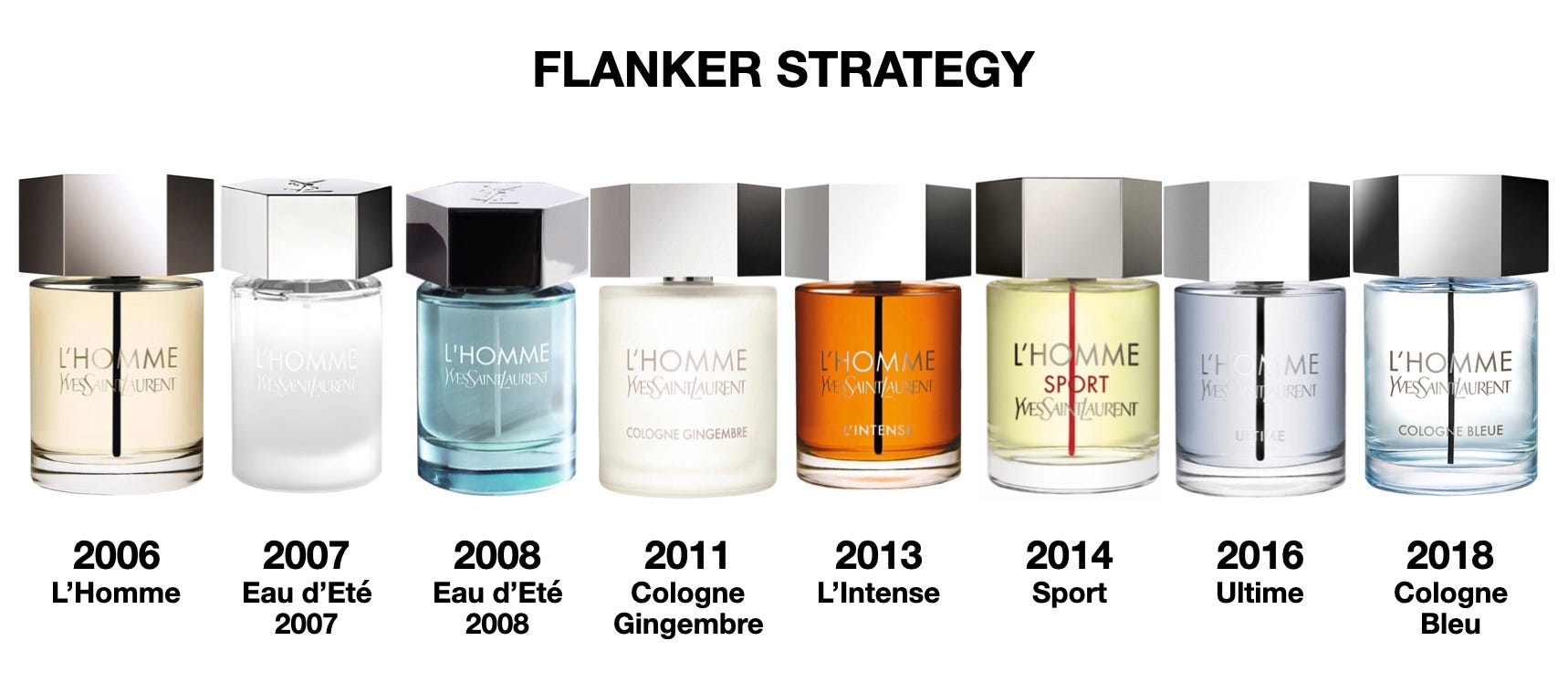
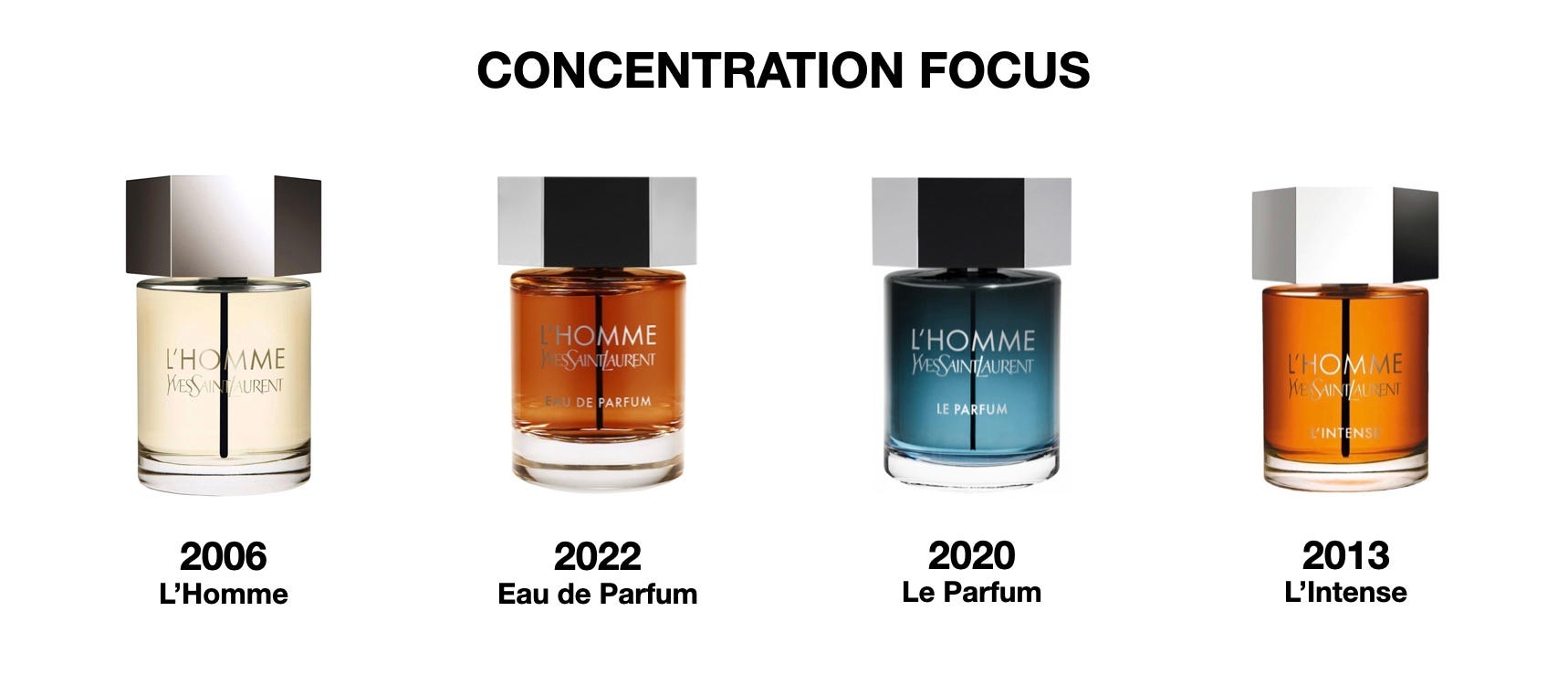
The playbook shifted after Bleu de CHANEL EDP successful launch in 2014. Then COVID-era demand for stronger, longer-lasting scents accelerated the shift. For example, YSL has since replaced the flanker carousel with a clear concentration ladder: L’Homme Eau de Toilette → Eau de Parfum → Le Parfum → Intense.
This streamlined the range while providing a straightforward upsell path.
Closing the knowledge gap
Reddit threads and #PerfumeTok have raised general fragrance literacy, but newcomers still need guidance around strength claims: what does a concentration percentage really mean or buying dupes that over-promise. It is a complex category but just as customers upped their skincare game and understand skincare ingredients and their benefits, these customers could benefit to learn the chemistry behind fragrances.
Myths & shortcuts
More oil = louder? Higher oil often boosts density but can cut projection: less alcohol, less lift..
“30 % concentrate” is 30 % of fragrance oil? No! As the figure includes solvents. Some dupes significantly increase the overall percentage of the concentrate by adding cheap solvents and ingredients with weak scents (Hedione). This makes it seem like the fragrance has a higher proportion of valuable scent materials when it doesn't.
Regulation void: A recent count reached a staggering 105 different concentrations. Terms like extrait or elixir have no legal definition, allowing opportunistic brands to increase prices under the assumption that it’s better quality.
Recognizing these shortcuts would help shoppers avoid overpaying for strength that exists only on the label. Ultimately, trust your nose!
Data visuals are the new blotters
Brands that want to educate now lead with graphics instead of guesswork:
Merit: pairs an explicit extrait definition with a wear-time bar that tops 12 hours.
Commodity: uses its “Scent Space” slider to explain how personal, expressive or bold the fragrance will be.
Fugazzi: uses infographics that map trail, longevity and concentration on one easy grid.
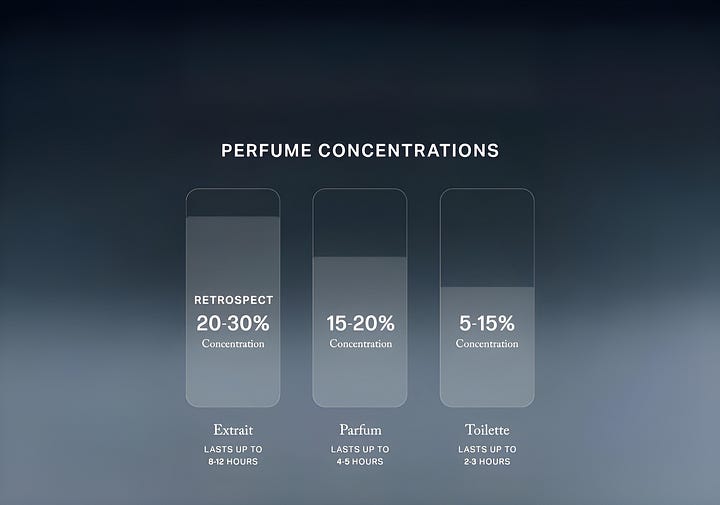
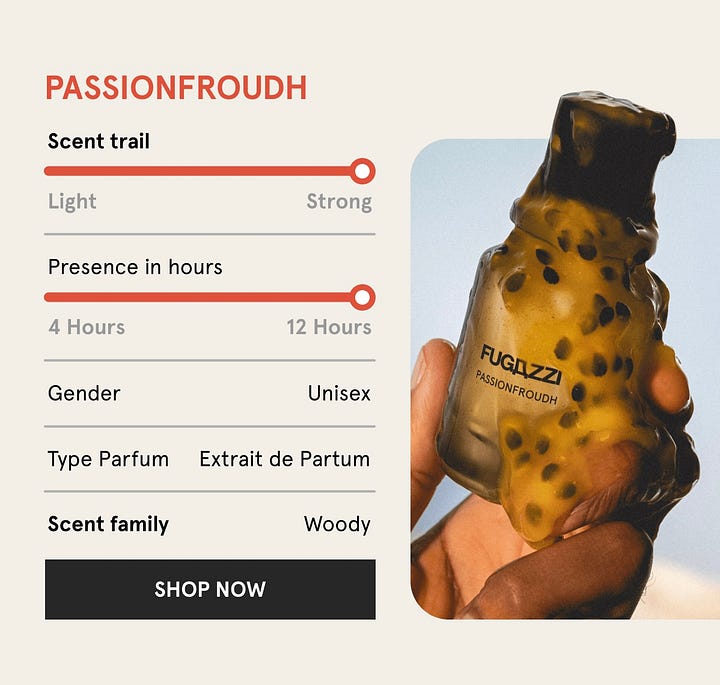


Such visual scorecards give online buyers an instant sense of intensity, sillage, and duration, essential when half of Gen Z are blind-buying fragrance.
The counter-trend — why soft still sells
Loud may grab headlines, yet subtle sells alongside it. “Skin scents” such as Glossier You and Phlur Missing Person are designed to sit close and remain among Sephora’s top performers. Consumers are building range: broadcasting when they want compliments, layering lighter formulas when they’d rather keep the scent to themselves. Brands that serve both impulses—power and discretion—will capture the full spectrum of modern fragrance desire.
I’m Pierre Vouard, founder of PJV Advisory.
I work with fragrance and beauty brands to decode cultural signals, build smart go-to-market strategies and launch products that actually resonate.
If you’re launching a brand, repositioning a product or just want to chat, feel free to reach out.
Very interesting...
I am in the camp of getting more and more subtle in my fragrance preferences. The Eau de Cologne genre is underrated and other than Hermes, I feel no one else does something significant in that domain (although even their range seems to have taken a backstage after JCE left).